

A decade-old Medium post always catches my eye: “How Much Do Freelance Writers Actually Make?” by Ryan McCready. He opens with how, in 2016, a majority of Americans were trying to nose their way into freelancing, no matter the industry. One person’s reason may be to earn a little cash, another’s to develop new skill sets. Over 53 million Americans were considered freelancers, and nearly a third of those were ‘moonlighting’ alongside a full-time job.
McCready leveraged the website Who Pays Writers?, an anonymous, crowd-sourced database of publications pay freelance writers (and how much). He analyzed 520 entries between 2014 and 2016. His conclusions, summarily, were grim. Most writers cannot survive the competitive freelance market by writing alone.
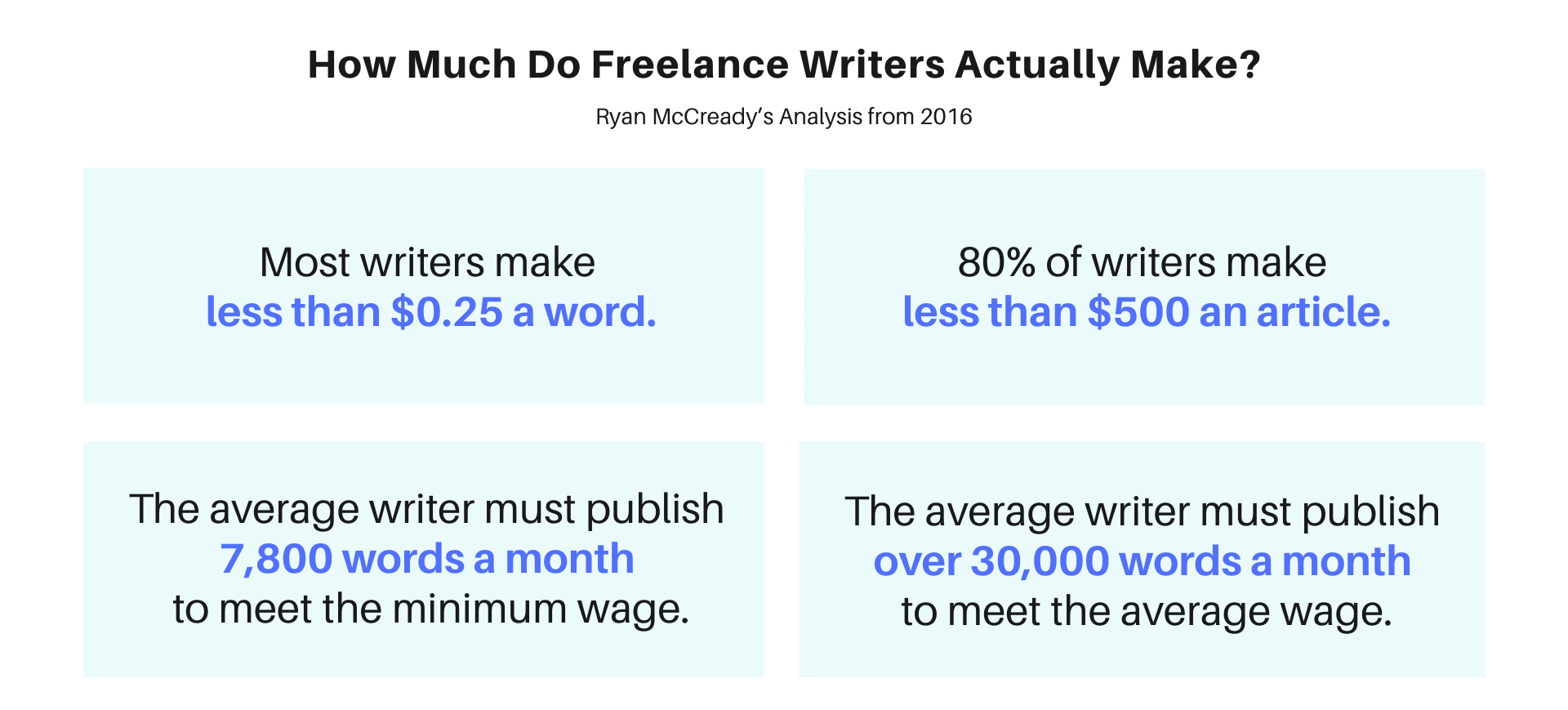
I entered the workforce as a science communicator in 2021, five years after McCready’s analysis. Today, 64 million people work as freelancers, and about half of them are Gen Z professionals like me. Every so often I return to McCready’s article for insight, but as time passes, I wonder how many of his conclusions remain true in 2026.
I’ve scraped over 5,600 entries detailing the pay rate, article length, when they were paid, and other information from publishers across the internet using Who Pays Writers. The data was originally captured from the website in February 2025 and is available here for transparency.
Writers care about being paid in dollars and cents. While writing for exposure is a tale as old as time, the object of desire is to make a living putting words to paper. Ryan McCready’s original analysis of the crowdsourced Who Pays Writers database divides payment into two categories: per word and per article.
Technically both categories will reflect the same information, but the distinction will make it easier to digest. An author paid two cents a word for a thousand words receives the same payment as an author paid twenty cents a word for a hundred words. Writers usually get paid by the word, but we also keep track of the clips, or articles, we write.
Let’s start with words.
How Much Is A Word Worth?
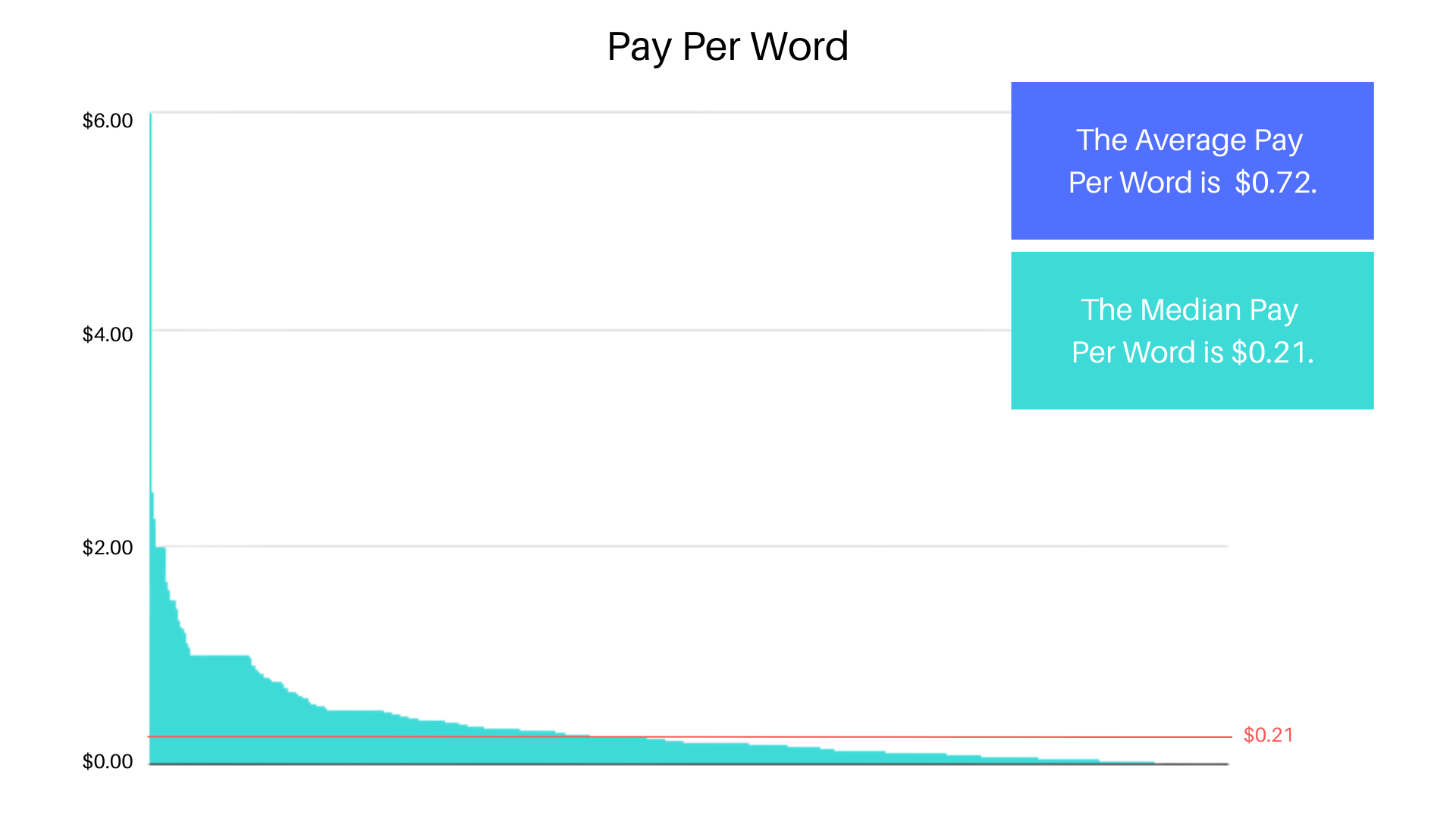
Ryan McCready’s original analysis concluded that the majority of freelance writers made around $0.17 per word. My 2025 data shows that the median pay rate has ticked upward to $0.21 per word. While this represents a modest 23% increase, it has failed to keep pace with the significantly higher inflation seen over the last decade.
Accounting for all 5,600 entries, the average pay sits at $0.72. To the far left of the chart, we can see one person was paid six dollars per word—unheard of in the journalist world. It makes the average top heavy, pulling it higher than what most people experience. The median pay for a freelance writer, by comparison, is $0.21. A median number takes the middle fifty percent, shaving off the top and bottom twenty-five percent of a sample which may reflect extreme or unusual situations. It should better reflect what the majority of writers experience in the freelance world.
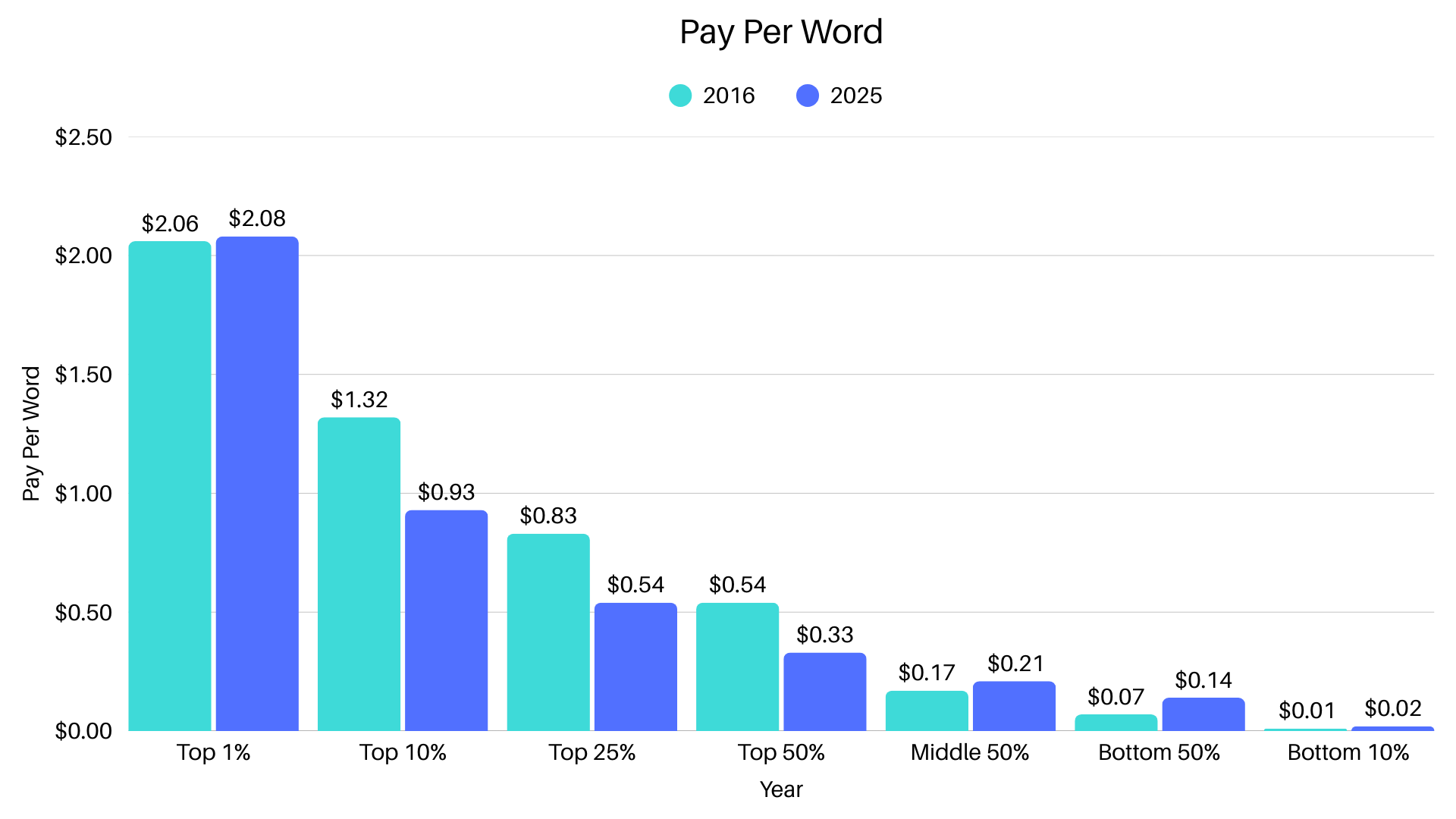
McCready’s original analysis points out that his data (like ours) is top heavy, which could lead to inaccurate conclusions later on. He breaks down the data into defining categories so the results are more easily understood. From his findings, he concluded that the majority of freelance writers make around seventeen cents per word. Our findings show that rate has raised to twenty-one cents per word.
The gap between the average writer and the elite has narrowed; the Top 10% now earns only 30% more than the mean, compared to 400% in 2016. This likely indicates that a larger volume of lower-paid writers is contributing to the database today. Results also show gains for Middle 50%, growing to $0.21. As we move towards the Bottom 50%, their pay per word rate has doubled. They’re earning a little less than half of what the Top 50% earn.
The Per-Article Reality
Freelance writers aren’t really concerned with word counts; they are concerned with “clips.” It may be easier to work on one large project that pays a “lower” pay per word count than writing several short projects with a “higher” pay per word count. While the average pay in my sample is $986 per article, over 80% of writers earn less than that. The majority of writers earn closer to $224 per article. This chart reflects a larger range than the first Pay Per Word chart.
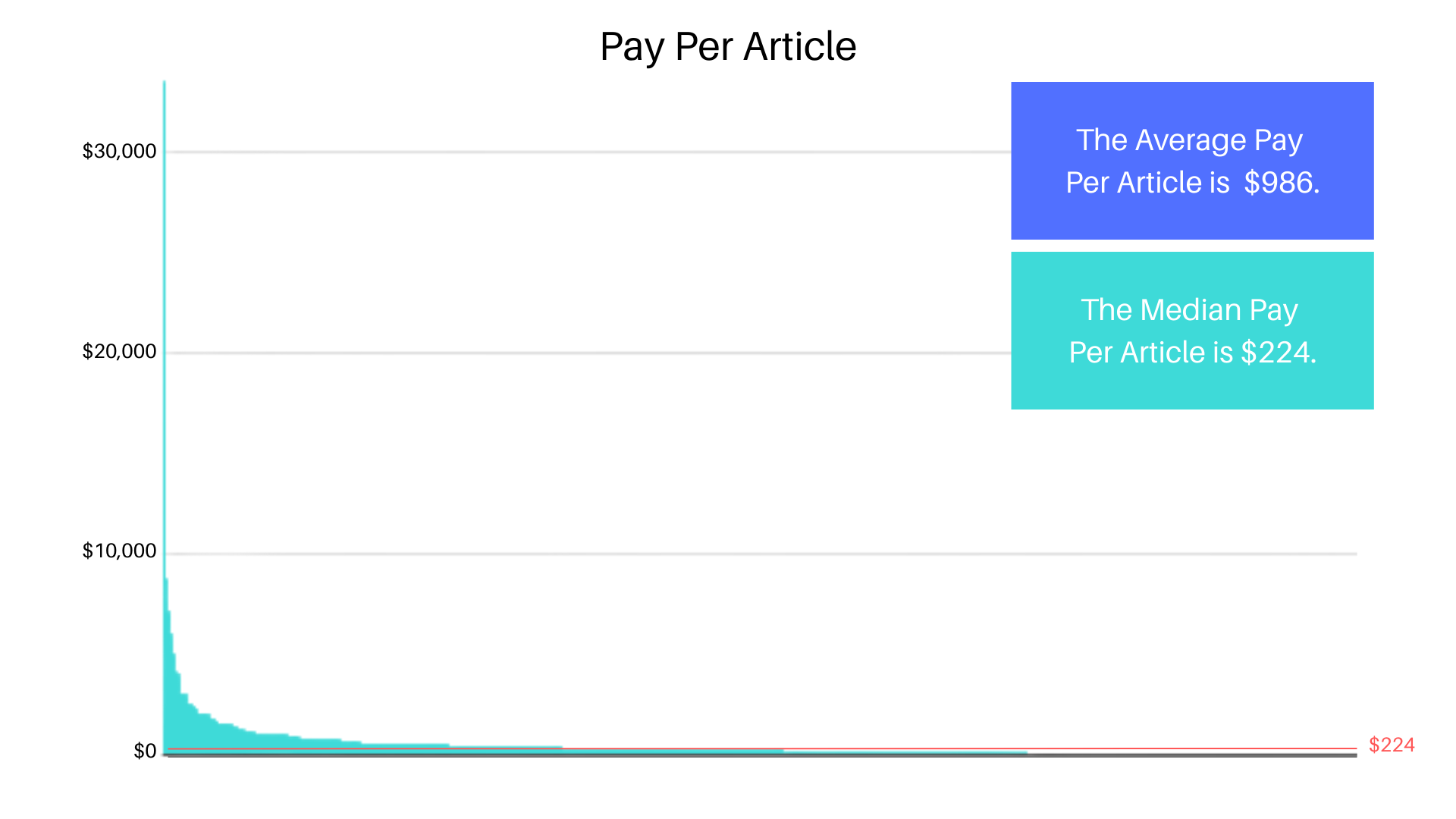
When digging into the Top 1%, the numbers appear highly skewed. One entry for Wired suggested a payment of $33,600 for an 8,000-word piece. While it’s possible a lucky freelancer earned half of an annual teacher’s salary from a single story, the more probable explanation is a data-entry error. This highlights the inherent risks of relying on unvetted, crowdsourced databases.
Just like with Pay Per Word data, I matched McCready’s segments with the Pay Per Article data. Here, we can see the Top 1%’s numbers appear very skewed. Could the average pay per article essentially double while the top 10% remained relatively the same?
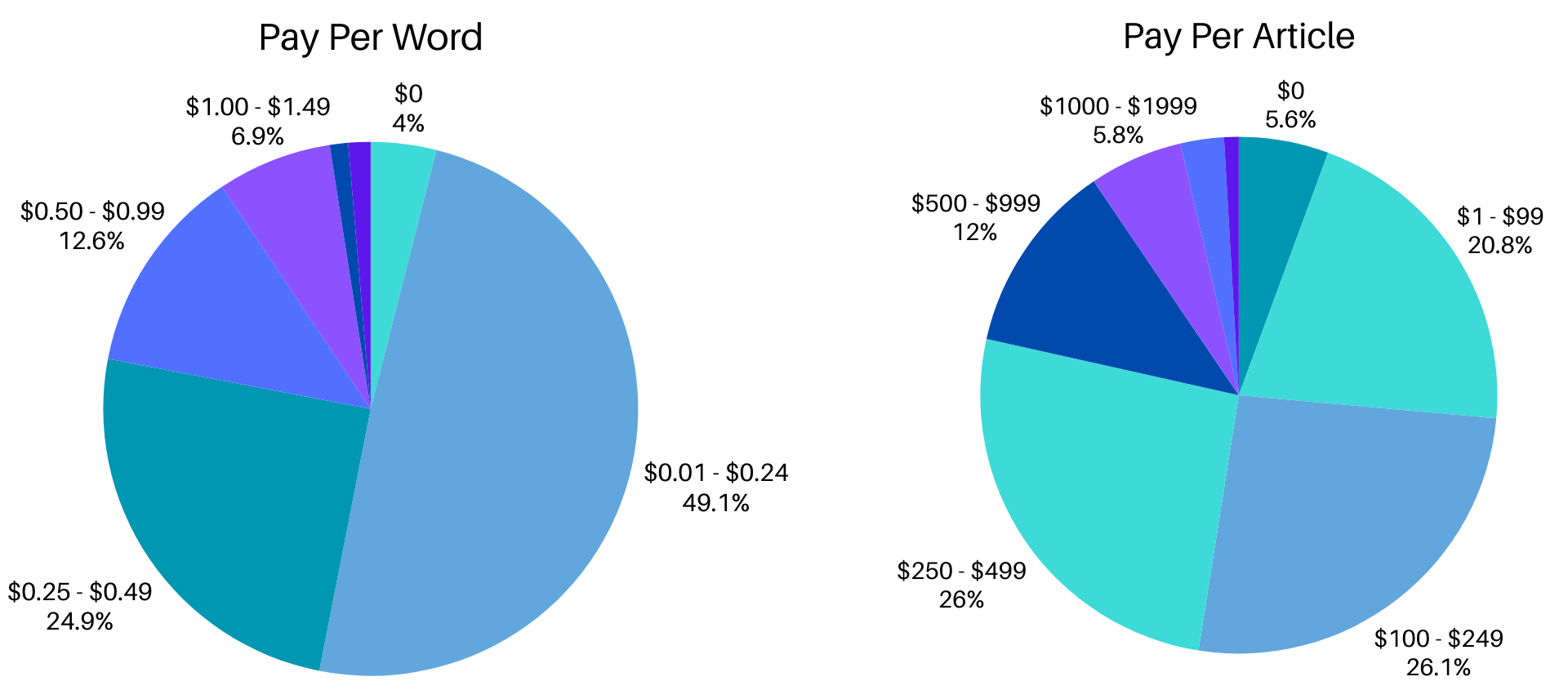
Despite these outliers, the trend is clear: nearly half of the articles submitted were paid less than $0.25 per word. While the percentage of writers making less than $250 an article has shrunk from 80% to 53% since 2016, the “ceiling” for traditional journalism feels lower than ever.
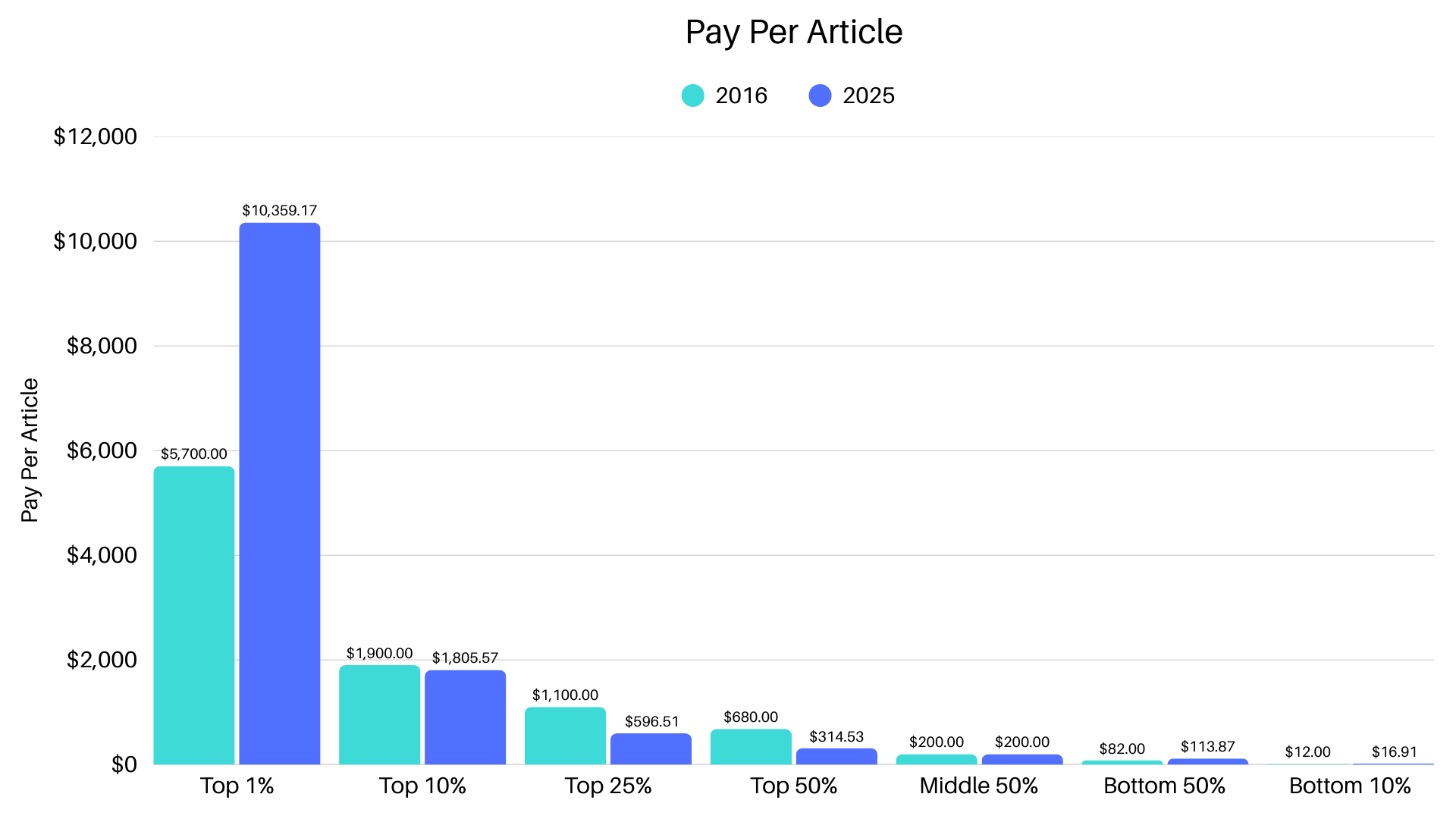
McCready checked his results by counting the number of articles in each of the selected ranges. Applying the same method, I found similar results. Nearly half of the articles submitted were paid less than twenty-five cents per word. Less than twenty-five percent earn more than fifty cents a word. While most writers are still making less than $250 an article, the percentage has significantly shrunk from 80% to 53%.
McCready’s conclusion in 2016 suggested only the top 10% of writers can afford to have freelance as their their sole source of income. My analysis shows that likely remains true, but perhaps the top 10% can’t make that meet needs anymore. Times have changed in the past decade, with both a evolving media environment and rising consumer prices. Writers may have the ability to earn income more easily—or more reliably—from other independent revenue sources like Patreon, Substack, and Ko-fi.
How Much Should I Write to Quit My Day Job?
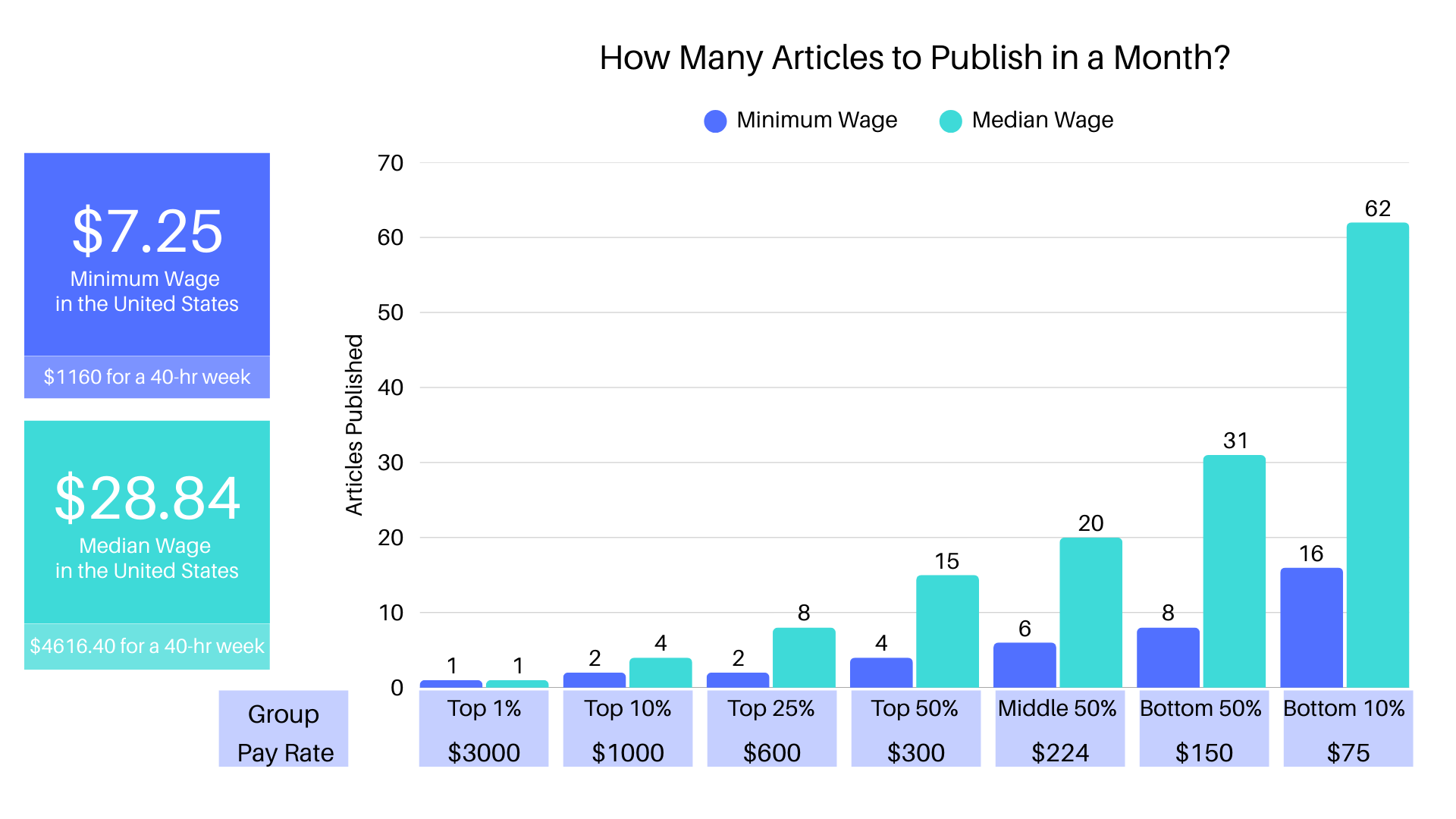
How much do you actually have to write to leave your day job? To clear the federal minimum wage ($7.25/hr), a writer in the Bottom 10% must churn out 16 articles a month—essentially one every other day. If you want to reach the American median wage of $28.84 an hour, that same writer would need to publish a staggering 62 pieces a month.
The burden of output becomes even more daunting when we shift our gaze from word counts to finished assignments. To clear the bar for the federal minimum wage, a writer in the Bottom 10% must churn out 16 articles a month—essentially one every other day—while those aiming for the American median wage of $28.84 an hour would need to publish a staggering 62 pieces in that same window. That is more than two finished, polished stories every single day of the month, including Sundays. By contrast, the “freelance elite” in the Top 1% only need to secure a single high-paying assignment to exceed that same monthly median wage. For the Middle 50%, the reality sits at a grueling 20 articles per month to reach the median lifestyle, a pace that leaves little room for the deep research or creative breathing room that high-level science communication requires.
So, here we are. A decade has passed, a global pandemic reshaped the workforce, and Gen Z has taken the helm of the freelance ship. What have we learned?
While the floor has risen slightly—with the bottom 50% of writers seeing modest gains in their per-word rates—the “ceiling” for traditional journalism feels lower than ever. The fact that a median writer must still produce the equivalent of a Roald Dahl novel every month just to hit a livable wage is a sobering reminder that the “starving artist” trope has simply been rebranded as the “hustling freelancer.”
However, the data reveals a shift in the way we work. In 2016, you were either a “successful” writer for a major masthead or you were struggling. In 2026, the middle ground is widening. We are no longer just selling words to publishers; we are selling brands to audiences. The modern freelancer isn’t just checking Who Pays Writers?; they are checking their Substack conversions and Patreon tiers.
If you want to survive on words alone, the traditional “per-word” model is a treadmill that only the top 1% can run comfortably. For the rest of us, the path to a sustainable career isn’t just about writing more words—it’s about owning where those words live.
The freelance dream isn’t dead, but it has evolved. To make a living today, you have to be more than a writer; you have to be your own publisher.
Takeaways for Today’s World
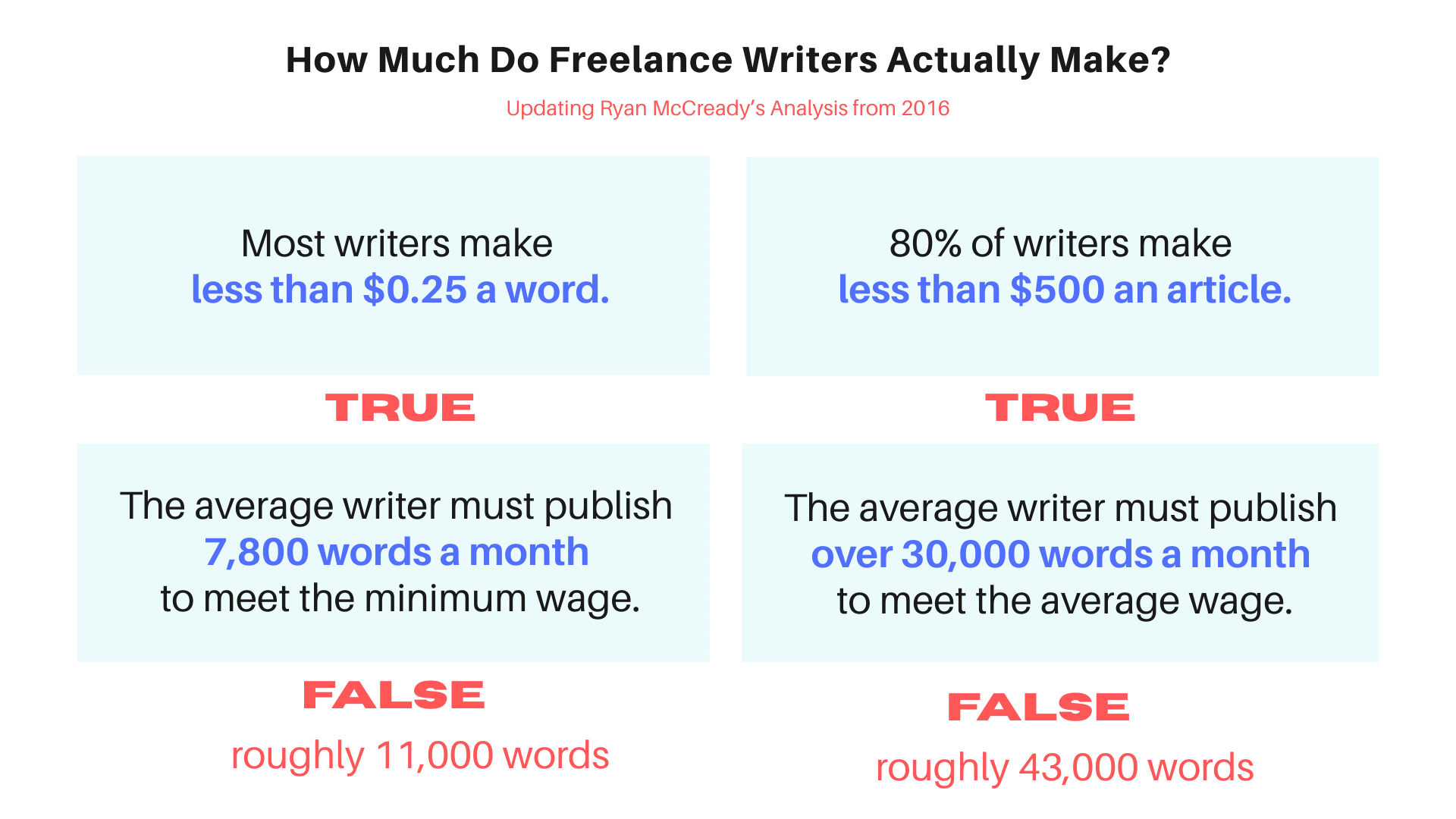
So, how do McCready’s 2016 benchmarks hold up today?
The treadmill hasn’t just maintained its pace; for the average freelancer, the incline has grown significantly steeper. To survive today, the path isn’t just about writing more—it’s about finding independent revenue sources like Substack or Patreon to supplement a model that hasn’t changed in a decade.
Special thanks to Nicole Williams from Come with Me for reviewing an early draft.
But writing speculative fiction, with all the research it entails to keep the plausibility realistic, keeps one's mind extra sharp. And I get to pretend I know what I'm talking about while still enjoying the wonder of space sciences 🚀🪐😉