

This is my personal opinion as a science communication expert. These opinions do not represent NASA or my employer.
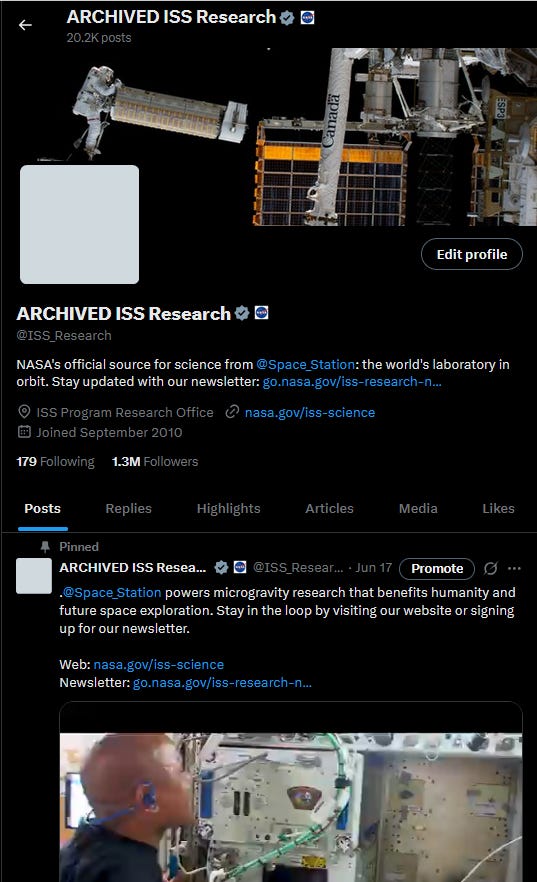
I watched the @ISS_Research account sunset on X today. My academic research made me feel like the NASA’s Social Media overhaul would only make the fight for science truth more difficult.
The American space agency decided to reduce its social media footprint by archiving dozens of social media accounts in June 2025. NASA will rely on the remaining thirty-five accounts to disseminate an avalanche of information. This consolidation effort is at the direction of the administrative suite, appointed by the current president. The efficiency argument is straightforward: streamline communication to help the audience focus on your core message.
For a government science agency, I disagree with the approach. Government science agencies have a responsibility to communicate to the public what research is being conducted with taxpayer funds.
The Public’s Changing Relationship with NASA
To understand why this decision concerns me, it's helpful to look at how public communication, especially for an agency like NASA, has evolved over time.
As outlined in my advertising thesis, published in 2021, there are four models for conducting effective public relations: publicity, public information, advocacy, and relationship building. Developed by Grunig and Hunt in the 1980s, a company’s approach to informing the public can fit one of these four models.
The first model, publicity, seeks to deceive or heavily influence the public. You can think of it as propaganda or a cover-up to misdirect the general public. One example is the tobacco industry in the 1960s minimizing health risks of cigarettes depsite understanding the impact of smoking on individuals and public health.
The second model, public information, focuses on educating the general public about a topic. From the 1960s through the 1980s, NASA relied on this model, which focused on sharing accurate information through mass media to influence the public’s interest in the space program. Walter Cronkite and Jules Bergman became household names from their coverage of the manned space program.
The third model, advocacy, adds a new element to the equation: two-way communication. While defined by the word 'advocacy' in academia, this approach fosters and facilitates discussions with the public about a topic. In the 1990s, NASA began tailoring its messaging to meet the needs of different groups of people. Communicators may share with a senator how NASA benefited their state’s economy or highlight how astronauts inspire kids to choose STEM degrees. Access to the internet and the ability for the space agency to publish their own content made this change possible.
The fourth model, relationship building, became readily available to NASA during the 2010s at the dawn of social media. NASA could invite the public to participate in their science efforts, from conducting open science missions to adding someone’s name to a Mars Rover Ridealong. Individuals could feel a personal connection to the space agency and find value in that relationship.
The shift towards this relationship-building model was a natural progression for NASA, recognizing that its mission extends beyond mere information dissemination. Crucially, this evolution underscores a point often forgotten in our profit-driven society: government agencies are not businesses.

Government Agencies Aren’t Businesses
We often forget that public goods do not have to be profitable. By definition, a public good is a commodity or service that benefits society (non-excludable) and does not reduce availability for others (non-rivalrous). Public schools, law enforcement, and roads are all examples of services that benefit everyone and is available to everyone.
Our capitalistic society focuses on generating wealth and privatizing goods. Science is a long-term endeavor that trickles knowledge over decades. Overtime, the benefits of science can emerge. One example, our long-term efforts to study nuetron stars using X-ray technologies led to a medical breakthrough for a better CT scan. The initial astrophysics technology was patented in 2015, but other researchers began exploring medical applications five years later. The discovery on both ends could not be rushed and used careful and calculated efforts to lead to their eureka moments.
As NASA continues to shrink its communications department (in addition to its social media presence), American citizens are losing access to the science and technology discoveries they fund with their tax dollars. If NASA does not communicate about scientific advancements it has completed, there is no way a medical researcher can make the connection between neutron stars and better CT scans. Science is not done until it is fully communicated. Science is a long-term investment in our society to making the world a better place.

Where the Agency (May) Stand
Given this understanding of science as a public good and a long-term investment, the agency's decision to drastically reduce its communication channels warrants a closer look. While I don't have all the internal information, here is my perspective on what these changes might mean for NASA. My perspective does not reflect NASA’s opinion or the opinion of my employer.
As the agency shared in many replies, NASA’s social media portfolio grew to more than 400 accounts across dozens of platforms. The goal of this social media consolidation effort is to reflect a more cohesive and simplified message across the agency to inform, educate, and inspire the public.
One potential problem is the firehose of information that still needs to be communicated to the public. Hundreds of those NASA-affiliated accounts are actively sharing updates about education opportunities, available data, and recent discoveries across the universe. By reducing to thirty-five accounts, a flood of information will still need to be shared, but there will be fewer ways to share it on social media.
There are many ways to get information from NASA, including newsletters and the agency website. However, social media has unique online relationship-building aspects that cannot be replicated in other models. Social media fosters conversations and interactive collaboration with the public on a nationwide scale. Creating a more unified message across fewer accounts could mean decreasing the dialogue with the public about the agency’s goals and missions. NASA may revert to a public information or advocacy model, depending on how these changes are fully realized.

What You Can Do
This change is implemented. I cannot speak to any reason why NASA would revert to its previous focus on a relationship-building model for online communications.
Looking at the bigger picture, if you want to support science and how its communicated with the public, Here are a few actions available to you:
Learn about NASA science conducted across the nation, planet, and solar system and how it benefits your life.
Educate yourself about the proposed cuts to NASA’s budget, which proposes to reduce funding for science programs by over 50%.
Make your voice heard by calling your political representatives with 5 Calls.
I've watched as some of my favorite accounts were archived. I understand the streamlining concept. I've sometimes wondered if there weren't too many NASA accounts, but I think you're correct that we will miss out on information as the SM accounts left shoulder responsibility for those that were archived.